

Every growing business eventually reaches a point where manual work starts slowing down progress. Team members spend countless hours copying information between spreadsheets, reading repetitive invoices, summarizing documents, and sending follow-up emails. While these tasks are necessary for day-to-day operations, they take valuable time away from strategic initiatives, client relationships, and business growth.
Custom artificial intelligence agents are changing how companies manage these daily operations. Unlike simple single-step automation tools, intelligent agents can understand instructions, examine information, make logical decisions within clear rules, and complete entire multi-step projects automatically.
Why Traditional Automation Tools Fall Short for Growing Teams
Most business owners have tried basic automation tools that follow simple if-this-then-that rules. While these tools work well for very simple tasks like sending a standard confirmation email when a form is submitted, they quickly break down whenever an unexpected situation occurs.
If an invoice format changes slightly, if a customer inquiry contains unusual wording, or if a data field is missing, traditional rules freeze and require human intervention. Custom AI agents overcome this limitation because they understand context, interpret unstructured text, and adapt intelligently to variations without throwing errors or halting operations.
How Coordinated AI Agent Teams Work Together Behind the Scenes
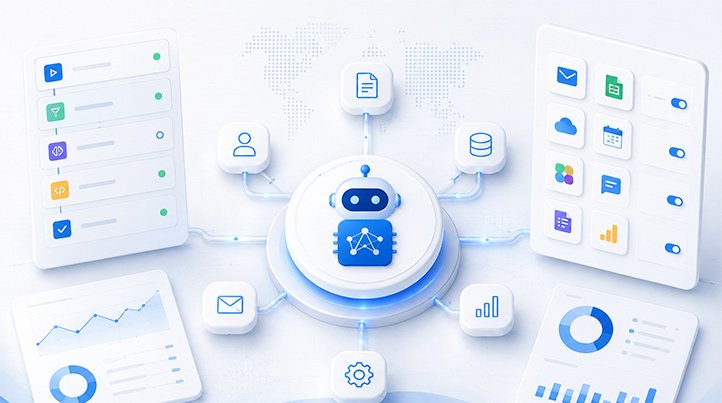
Rather than relying on one single AI prompt to handle an entire business department, modern automation relies on specialized agent teams. Think of this approach like a well-organized office where different team members have distinct roles and work collaboratively toward a shared outcome.
Breaking Large Projects into Manageable Action Steps
When a complex task enters the pipeline—such as processing a new client onboarding file—the coordinator agent reviews the requirements and divides the work among specialized helper agents. One agent extracts and verifies client details, another cross-references information with historical records, and a third agent prepares the formatted summary for review. This division of responsibility ensures high speed, exceptional accuracy, and zero confusion.
Connecting Safely with Your Existing Software and Databases
Intelligent agents are designed to work directly inside your existing business ecosystem. They connect securely with your CRM, accounting software, cloud storage, and internal databases through standard APIs. Because all actions take place within private, encrypted environments with strict boundary rules, your sensitive business data remains protected at all times.
Real-World Examples of AI Workflow Automation in Action
Businesses across diverse industries are already deploying custom agent workflows to save hundreds of hours every month. Here are three common ways companies put these systems to work:
- Automated Invoice and Expense Processing: An agent team automatically reads incoming PDF invoices from your inbox, checks item totals against purchase orders, flags discrepancies for review, and enters approved numbers into your accounting software.
- Overnight Competitor and Market Research: A research agent gathers public industry updates, product pricing changes, and regulatory news every night, delivering a concise briefing to your leadership team before morning meetings.
- Smart Customer Lead Routing and Follow-Up: Inbound leads from multiple marketing channels are analyzed, enriched with relevant business background, categorized by priority, and scheduled directly into sales representatives’ calendars.
Key Steps to Successfully Deploy Custom AI Agents
Implementing AI workflow automation is straightforward when approached with a structured plan. Successful deployments typically follow three practical steps:
First, identify your team’s most time-consuming repetitive processes where the rules and desired outcomes are clearly understood. Second, define exact boundaries and safety checks, ensuring that high-stakes actions like financial transfers or critical record updates require human approval. Third, test the agents in a secure staging sandbox where your team can review real-life sample workflows before going live in production.
The Measurable Business Impact of Intelligent Workflow Automation
The primary advantage of deploying custom AI agents is operational freedom. Companies that implement automated agent workflows report saving between 20 to 40 hours per team member each month, while virtually eliminating data entry errors and speeding up customer delivery times.
When routine tasks execute reliably in the background, your human employees can focus their energy on creative problem-solving, strategic innovation, and building meaningful relationships with your clients.
Final Thoughts on Scaling Your Business with AI
Autonomous AI workflows are no longer experimental concepts reserved for tech giants—they are practical, accessible business tools that give ambitious companies a decisive operational advantage. By automating repetitive administrative tasks with intelligent agents, you can build an agile, scalable business ready for sustained growth.
If you are ready to identify the best automation opportunities in your business, the team at Direct Impact is here to help you architect and deploy a custom AI agent solution tailored to your exact operational goals.